
Need help?

Annika Jansen
Are you looking for a Canon mirrorless camera and deciding between the EOS R5, R6 Mark II, R6, or R7? We'll help you choose. These four models are part of Canon's popular EOS R series, but each targets a different type of photographer.
All models share much of the same modern technology, such as the RF lens mount and fast autofocus, but differ significantly in resolution, video capabilities, build quality, and price. Here we take a deeper look at the features, strengths, and use cases of these cameras side by side, so you can better determine which Canon best suits your photography or video style.
Although these four Canon models all belong to the EOS R series and use the RF lens mount and the fast DIGIC X image processor, they are designed with different users in mind. The biggest differences lie in the sensor, speed, video capabilities, build quality, and target audience.
The most notable difference is the sensor format. The EOS R5, R6, and R6 Mark II have a full-frame sensor, ideal for maximum image quality, low-light performance, and a shallow depth of field. The EOS R7, on the other hand, has an APS-C sensor, which thanks to the crop factor provides more reach in wildlife and sports photography.
In terms of resolution, the EOS R5 stands far ahead with 45 megapixels — perfect for large prints, commercial work, or heavy cropping. The R7 follows with 32.5 MP, which is high for an APS-C camera. The R6 Mark II sits in between with 24.2 MP, while the original R6 has 20.1 MP.
For sports or action photography, speed and buffer are important. The EOS R6 Mark II offers the highest speed with 40 frames per second (electronic shutter). The R7 reaches 30 fps, while the R6 and R5 top out at 20 fps. The buffer also differs significantly: the R6 Mark II can handle 1,000+ JPEGs at 20 fps, while the R7 fills up faster at 126 JPEGs.
Are you a video creator? Then the EOS R5 is the most future-proof with 8K video up to 30p and a high bitrate of approximately 1,300 Mbps. The other models all offer 4K 60p, but with a lower bitrate (between 170 and 340 Mbps). The R6 Mark II and R7 also feature a longer video recording time of up to 6 hours, while the other models typically cap around 30 minutes.
All models feature in-body image stabilization (IBIS), which helps produce sharp images handheld, especially at slower shutter speeds or during video recording. In use, the R7 is the lightest (612 g) and has the longest battery life, up to 770 shots. The R6 Mark II also scores well with 510 shots, while the EOS R5 and original R6 score slightly lower.
The EOS R5 stands out with a highly detailed viewfinder of 5.76 million dots and a large 3.15" screen. The other models have a lower-resolution viewfinder and a slightly smaller screen. In terms of storage, the R5 is also unique with a CFexpress slot + SD card slot, which is necessary for 8K recordings. The other models use two SD card slots, but vary in speed (UHS-I or UHS-II).
 EOS R5 |
 EOS R6 Mark II |
 EOS R6 |
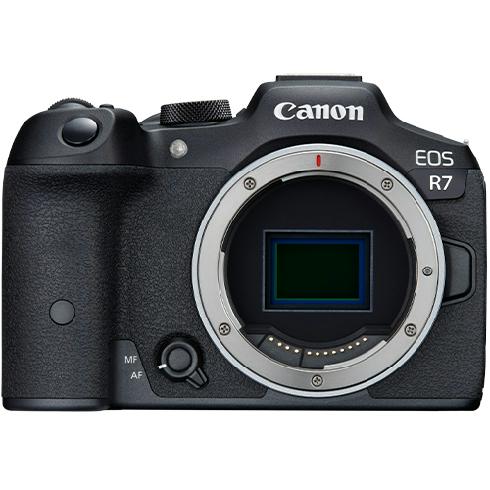 EOS R7 |
|
|---|---|---|---|---|
| Sensor | Full-frame CMOS | Full-frame CMOS | Full-frame CMOS | APS-C CMOS |
| Megapixels | 45 | 24.2 | 20.1 | 32.5 |
| Image processor | DIGIC X | DIGIC X | DIGIC X | DIGIC X |
| Autofocus | Dual Pixel CMOS AF II | Dual Pixel CMOS AF II | Dual Pixel CMOS AF II | Dual Pixel CMOS AF II |
| Autofocus points | 1,053 | 4,897 | 1,053 | 651 |
| Autofocus in low light | -6 EV | -6.5 EV | -6.5 EV | -5 EV |
| ISO | 100–51,200 | 100–102,400 | 100–102,400 | 100–32,000 |
| Frames per second | Up to 20 fps | Up to 40 fps | Up to 20 fps | Up to 30 fps |
| Continuous shooting (buffer) | 350 JPEG / 180 RAW | 190+ JPEG / 75 RAW | 1,000+ JPEG / 120 RAW | 126 JPEG / 42 RAW |
| Maximum video resolution | 8K (30p) | 4K (60p) | 4K (60p) | 4K (60p) |
| Bitrate | approx. 1,300 Mbps | approx. 340 Mbps | approx. 340 Mbps | approx. 170 Mbps |
| Video recording limit | 30 min | 6 hrs* | 30 min | 6 hrs** |
| High dynamic range | Canon Log 1 & 3 | Canon Log 3 | Canon Log 1 & 3 | Canon Log 3 |
| Battery life | 490 shots | 760 shots | 510 shots | 770 shots |
| Storage | CFexpress + SD UHS-II | 2x SD UHS-II | 2x SD UHS-I | 2x SD UHS-II |
| Viewfinder | 0.5" / 5.76 Mdots | 0.5" / 3.69 Mdots | 0.5" / 3.69 Mdots | 0.5" / 2.36 Mdots |
| LCD screen | 3.15" / 2.1 Mdots | 3" / 1.62 Mdots | 3" / 1.62 Mdots | 3" / 1.62 Mdots |
| Dimensions | 138.5×97.5×88 mm | 138.4×98.4×88.4 mm | 138.4×97.5×88.4 mm | 132.0×90.4×91.7 mm |
| Weight | 738 g | 670 g | 680 g | 612 g |
| Introduced | July 2020 | November 2022 | July 2020 | June 2022 |
* The EOS R6 Mark II has no artificial recording limit, but at the highest video quality a 40-minute limit applies due to overheating.
** The EOS R7 has a 6-hour limit, but at the highest video quality a 60-minute limit applies due to overheating.
Advantages
Disadvantages
Advantages
Disadvantages
Advantages
Disadvantages
Advantages
Disadvantages
Every Canon EOS camera in this lineup has its own character and was developed with a specific user in mind. The Canon EOS R5 is designed for image makers who work with high detail, large file formats, or high-quality video. The EOS R6 Mark II is aimed at photographers who need speed and reliable performance, especially for action or hybrid use. The EOS R6 provides a solid foundation for those who want to combine powerful image quality with simple controls. The EOS R7 is compact, fast, and particularly suited for sports, wildlife, or travel photography thanks to its APS-C sensor and high megapixel count.
Look carefully at what matters most to you: resolution, speed, video capabilities, or portability. Not sure which one to choose? Our specialists in store are happy to help. Prefer to compare online? Browse all models on kamera-express.nl and find the camera that truly suits your way of working.

Our experts are ready for you

Call us
0148 071 0000

Email an expert
Response within 24 hours (except Sunday)
Never overpay – a fair price every day
Not happy? 14-day return period
Everything for photo and video: 16,000+ products


